Three picks cover almost everyone: a top pick that suits most people, a professional upgrade for serious RF work, and a budget pick that gives up the least for the money. Each entry below says whether I own the meter and measured with it, or am recommending it on specs and other reviewers’ results. One piece of advice before the picks: the meter is the one purchase in this whole subject worth doing properly. Buy the best you can reasonably afford, because the measurements, comparisons, and decisions you make afterward all stand on it.
Affiliate disclosure: some links here are affiliate links. Buy through one and I may earn a small commission, at no extra cost to you. Full disclosure.
1. TriField TF2
The TriField TF2 is my top pick and the meter I hand people who ask me what to buy with no further questions. Tested by me. I own it and bought it myself.
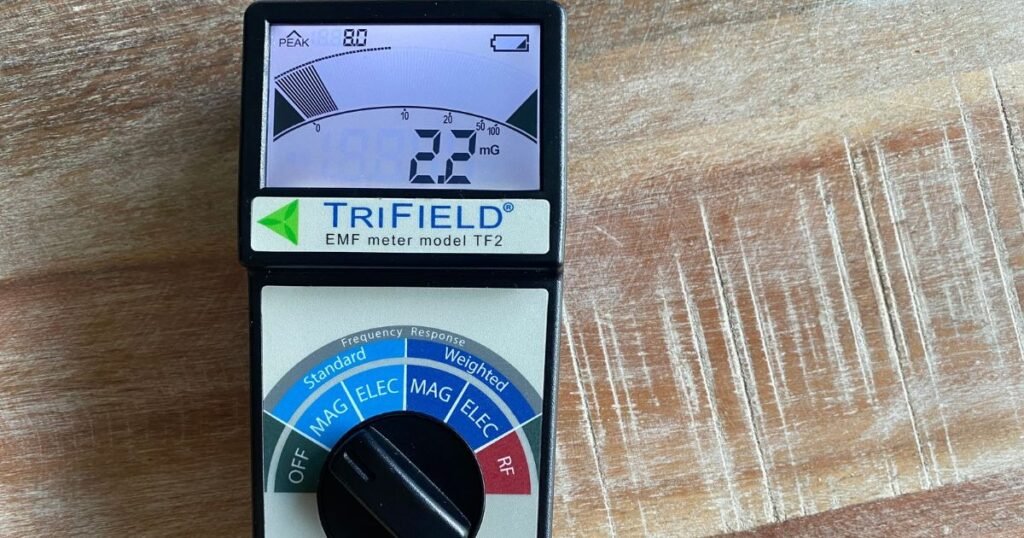
It reads all three field types, its three-axis magnetic mode removes the biggest beginner technique error, and its one-dial simplicity means you take trustworthy readings on day one. It is the meter this site’s methods were built around.
Best for: most people, first meters, and full home walkthroughs.
In my testing, the TF2’s magnetic and electric modes give me the most repeatable readings I take. Ten to thirteen mG at six inches from my running microwave, falling to under 3 mG at four feet, which is my house’s own background level.
RF mode behaves differently, and I want to be honest about that rather than sell you a steadier meter than I own. One foot from my router under load, it pegged its ceiling on three readings out of four. The TF2 stops at 19.999 mW/m², so what I actually know is that the level was above that, not how far above.
Its honest limits: single-axis RF that cares how you point it, no logging, and nothing above roughly 6 GHz, so 5G’s millimeter-wave band needs a separate meter built for it.
2. Safe and Sound Pro II (RF Only)
The Safe and Sound Pro II is the meter I use to check my other meters, and the one to buy when RF is your specific, serious concern. Tested by me. I own it and bought it myself.
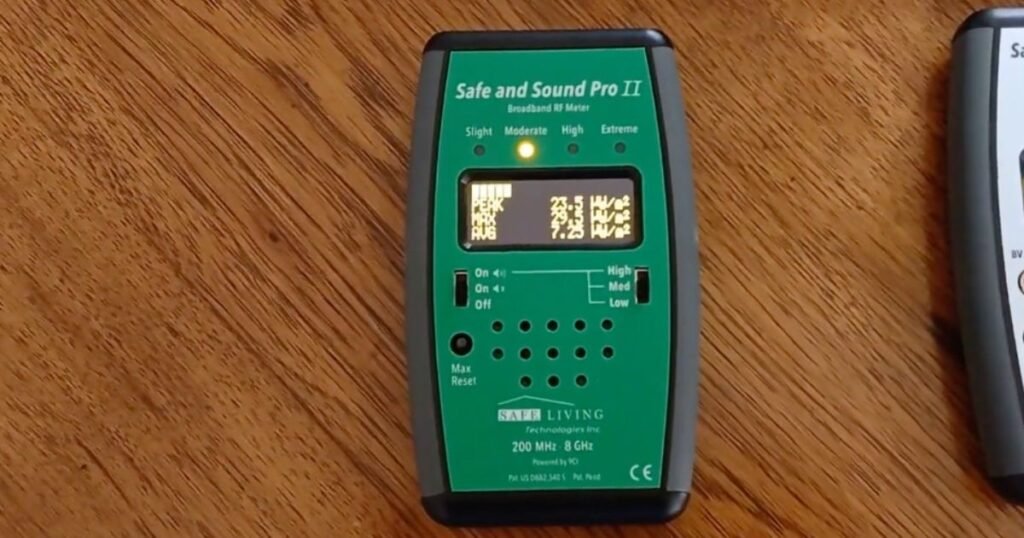
It measures RF only, but with a sensitivity floor low enough to resolve the strictest precautionary sleeping-area targets, levels my consumer meters simply display as zero, and a response speed that catches burst peaks the all-in-ones smooth over. It is the meter working building biologists actually carry. It also costs several times what an all-in-one does.
Best for: verifying readings, serious RF investigation, and measuring quiet bedrooms against the strictest precautionary bands.
That sensitivity floor is the reason I keep it. It resolves levels my all-in-ones show as a flat zero, which is the range the strict precautionary sleeping-area bands are written in, and its audio output identifies source types by ear faster than any display does.
Its honest limits are structural: RF only, so it cannot walk a house alone, no logging, and a professional price that is genuine overkill for checking whether moving a router helped.
3. GQ EMF-390
The GQ EMF-390 is the most measurement per dollar in my kit, and the right budget pick precisely because it is not a stripped-down compromise. Tested by me. I own it and bought it myself.
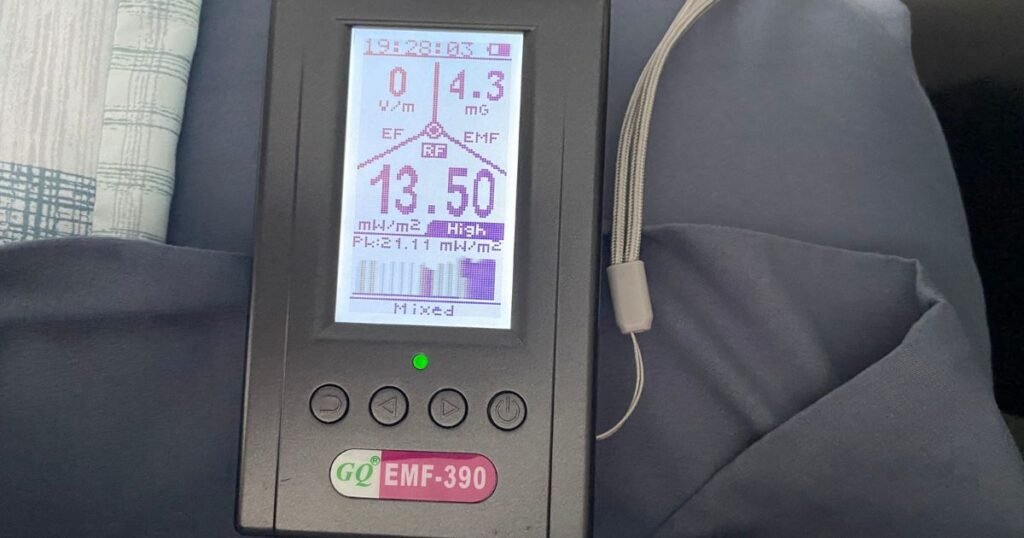
It reads all three field types with three-axis magnetic sensing, and it adds data logging and a live RF band display that even my top pick lacks. What it costs you is polish: a busy, menu-driven interface with a real learning curve, a light plastic build, and spec-sheet claims at the edges that deserve more skepticism than its everyday readings.
Best for: tight budgets, data-minded owners, and anyone who wants overnight logging.
In my testing, the EMF-390 followed the same falloff shapes as my TriField on the sources I measured with both: 20 mG at an inch from the running microwave, and router peaks around 33,000 µW/m² at one foot.
On magnetic readings it ran consistently a few tenths of a milligauss above the TriField in the same spot, every room I checked. That is the sort of thing you only find out by carrying two meters, and it is why I do not treat any single number as the number.
Plan on an evening with the manual, and treat its “possible source” labels as hints rather than verdicts.
The Top Three EMF Meters Side by Side
TriField TF2
- Reads: magnetic (3-axis), electric, RF
- Personality: one dial, clean numbers, zero confusion
- Weak spot: single-axis RF, no logging
Safe and Sound Pro II
- Reads: RF only, at professional sensitivity
- Personality: the reference meter, with audio source signatures
- Weak spot: price, and it cannot survey a home alone
GQ EMF-390
- Reads: magnetic (3-axis), electric, RF
- Personality: the data lab, with logging and a band display
- Weak spot: busy interface, lighter build, edge-spec optimism
How to Choose in Thirty Seconds
Most people: the TF2, and done. Tight budget or you love data: the EMF-390, and spend the evening learning it. RF is your specific serious concern, or you want readings that can stand behind themselves: the Pro II, alongside an all-in-one rather than instead of one. If you are still torn between the two all-in-ones, the difference is temperament, not capability: simplicity versus features.
What I Left Off This Page, and Why
Phone apps are not on this list because they cannot do the job; they read rough magnetic values at best and cannot measure RF at all. No-name marketplace meters are not here because I will not put my name on a meter with no published specs and no way to check them, tested or not. I own and am testing additional meters, the Cornet ED88TPlus, ErickHill ER02, and Latnex AF-5000 among them, bought with my own money so I can test what readers are actually considering. This page gets updated as verdicts earn their place.
Frequently Asked Questions
How much does a good EMF meter cost?
The all-in-ones on this page sit in the consumer tier, and the professional pick costs several times that. Below the budget pick’s price, you are mostly buying toys; above the pro pick, you are into specialized meters beyond home use.
Do I need to buy the professional meter?
Almost certainly not, and I say that as someone who earns a commission if you buy one: the free-and-easy changes this site teaches are fully served by either all-in-one. The Pro II earns its price for specific RF questions and for verification work, not for everyday home measuring.
Which meter do professionals actually use?
For RF, the Safe and Sound line is genuinely standard in building-biology kits, which is why it is my reference. Professionals also carry dedicated magnetic and electric meters at prices that make no sense for home use, which is what all-in-ones exist to approximate.
Should I buy two meters?
Start with one all-in-one and let real questions justify anything further. My kit grew one honest question at a time, and the second meter that earns its place first for most enthusiasts is a logger or a dedicated RF unit, not a duplicate.
Related Reading
- What Is an EMF Meter and Which Type Do You Need?
- How to Read an EMF Meter: What the Numbers and Units Mean
- Single-Axis vs. Three-Axis Meters, Explained
- How I Test